

Running Meta Ads is technically simple.

You can create an account, choose an objective, select an audience, upload a creative, set a budget and publish.
But getting profitable results is a different story.
A campaign can generate thousands of impressions, clicks and even leads while still losing money.
That is why successful Meta advertising is not just about knowing where to click inside Ads Manager. It is about understanding the relationship between creative, audience, offer, funnel, tracking and business results.
For a small business, the real question isn’t:
“How do I run a Facebook ad?”
It is:
“How do I run Meta Ads that generate customers profitably?”
This guide explains both sides: how to set up a Meta campaign and how to approach the execution if your goal is leads, sales and ROI.
What Are Meta Ads?
Meta Ads are paid advertisements that can be delivered across Meta’s ecosystem, including Facebook and Instagram, depending on the campaign setup and available placements.
Businesses can use Meta advertising for different objectives, including:
- Lead generation
- Sales
- Website traffic
- Engagement
- App promotion
- Brand awareness
- Customer acquisition
- Retargeting
Meta’s advertising system allows advertisers to define campaign objectives, audiences, budgets, placements and creative assets. However, modern Meta advertising increasingly relies on automation and machine learning to determine which people are most likely to take the desired action.
That means advertisers should not think of targeting as something they completely control.
Instead, think of it as a system you influence with inputs.
Your creative, offer, conversion event, audience signals and historical performance all provide information that can affect how the system delivers your ads.
Step 1: Set Up Your Meta Business Assets
Before launching your first campaign, you need the basic business infrastructure.
This generally includes:
- A Facebook Page
- An Instagram professional account, if applicable
- A Meta Business Portfolio
- An advertising account
- A payment method
- Appropriate business and account permissions
You will manage your campaigns through Meta Ads Manager, where campaigns, ad sets, advertisements, budgets and performance data are controlled.
Don’t rush through this stage.
If your business is going to spend money on advertising, make sure the account structure, access permissions and payment details are properly configured from the beginning.
Step 2: Decide What You Actually Want the Campaign to Achieve
Before opening Ads Manager, answer one question:
What does success look like?
If you’re a service business, your goal might be qualified leads.
If you’re an e-commerce company, it might be purchases.
If you’re promoting an app, it might be installations or valuable in-app actions.
The campaign objective should reflect the business outcome you want Meta to optimize toward.
For example:
Web development company
Ad → Landing page → Enquiry → Sales call → Customer
The goal isn’t simply traffic.
The goal is ultimately revenue.
This distinction matters because optimizing for clicks when you actually need customers can lead to a campaign that produces plenty of inexpensive traffic but very few valuable prospects.
Step 3: Build the Campaign Structure
Meta Ads generally follows a three-level structure:
Campaign
This is where you define the overall campaign objective and high-level settings.
Ad Set
This is where you manage elements such as audience, budget, schedule and placements, depending on the campaign configuration.
Ad
This is what the customer actually sees.
It contains the:
- Image or video
- Primary text
- Headline
- CTA
- Destination
- Other creative elements
Think of it like this:
Campaign = What are we trying to achieve?
Ad Set = Who and where are we testing?
Ad = What are we saying to the customer?
Keeping this structure clear makes testing and analysis much easier.
Step 4: Define Your Audience — But Don’t Overestimate Targeting
This is where Meta Ads have changed significantly.
Traditionally, advertisers spent a lot of time building highly specific audiences based on interests, demographics and behaviours.
Those controls still matter in the right circumstances.
But modern Meta advertising is heavily influenced by automation.
Meta can use its systems to identify people who are likely to take the action you have optimized for.
So instead of trying to predict every person who might buy from you, your job is increasingly to give Meta good inputs and enough conversion signals.
For example, a WebDreams campaign could start with a broad business audience.
But the creative itself can call out the intended customer:
“SME owners: Is your website generating traffic but no enquiries?”
A business owner who identifies with that problem is more likely to stop and pay attention.
This is why creative can function as an additional form of audience qualification.
Step 5: Understand the Idea of “Creative as Targeting”
This is one of the most important ideas in modern Meta advertising.
Suppose you are selling website development.
Instead of creating one generic advertisement:
“Professional Website Development Services”
you create several creatives aimed at different problems.
Creative A — SME Owner
“Your business has grown. Has your website?”
Creative B — Lead Generation
“Getting website visitors but no enquiries?”
Creative C — E-commerce
“Your online store gets traffic. Why aren’t visitors buying?”
Creative D — Startup
“Starting a business? Don’t launch with a website that looks like 2015.”
The targeting settings might be similar.
The message changes the audience that responds.
This is why the first few seconds of a video or the first line of an advertisement matter so much.
A strong creative should quickly communicate:
Who is this for?
What problem does it address?
Why should I care?
What should I do next?
The better the message matches the right person’s problem, the more useful the response data becomes.
Meta has also documented creative testing as a way to compare different creative variables and identify what performs better.
Step 6: Create Multiple Ads — Don’t Bet Everything on One Creative
One of the biggest mistakes businesses make is creating one advertisement and putting the entire budget behind it.
You don’t know whether it is actually your best creative.
Instead, build variations.
You could test:
- Different hooks
- Different opening three seconds
- Different images
- Different videos
- Different headlines
- Different offers
- Different CTAs
- Different pain points
- Different landing pages
For example:
Version A
“Your website is losing customers.”
Version B
“5 signs your business needs a new website.”
Version C
“Getting traffic but no enquiries?”
Same service.
Different angle.
Now the campaign can provide information about which message attracts the strongest response.
Step 7: Make the First Three Seconds Count
For video advertising, don’t spend the opening seconds introducing your company.
Don’t start with:
“Hi, we are WebDreams and we have been providing digital solutions for…”
The customer doesn’t care yet.
Start with the problem.
For example:
“Your website looks good. So why aren’t you getting enquiries?”
Or:
“If you’re still boosting Facebook posts, stop for a second.”
Or:
“SME owners: your website may be costing you leads.”
The first few seconds need to earn attention.
Then explain the problem.
Then present the solution.
Then give the customer a reason to take action.
Step 8: Build the Funnel Before You Launch the Ad
An advertisement doesn’t exist by itself.
It is the first step in a funnel.
For a lead-generation campaign, the journey might look like:
Ad → Landing Page → Lead Form → Sales Follow-Up → Qualified Lead → Customer
For WhatsApp:
Ad → WhatsApp → Conversation → Qualification → Sales → Customer
For e-commerce:
Ad → Product Page → Add to Cart → Checkout → Purchase
Every step can affect your final ROI.
Imagine your Meta campaign generates cheap leads.
That sounds good.
But if those leads don’t respond to your sales team, they don’t become customers.
Or imagine your advertisement generates excellent traffic but your landing page doesn’t convince visitors to contact you.
The problem isn’t necessarily the advertisement.
It could be the funnel.
That’s why we recommend testing the entire customer journey, not just the ad.
Step 9: Install Tracking Before Spending Serious Money
If you cannot measure what happens after someone clicks your advertisement, optimization becomes much harder.
For website campaigns, tracking can help you understand important actions such as:
- Page visits
- Lead submissions
- Purchases
- Add-to-cart events
- Other conversion events
Meta’s tracking and measurement tools can provide signals that help connect advertising activity with actions taken on your website.
For businesses focused on leads or sales, tracking should be considered part of the campaign setup — not something to add later.
Your goal should be to answer:
Which campaign generated the customer?
Which creative generated the lead?
Which audience produced the highest-value customers?
What did it cost to acquire them?
Step 10: Launch With a Testing Mindset
Your first campaign isn’t supposed to reveal the perfect strategy immediately.
It is supposed to generate information.
You might discover that:
- Creative A gets the most clicks
- Creative B gets fewer clicks but better leads
- Creative C gets cheap leads that don’t convert
- Landing Page A converts better than Landing Page B
- One offer generates more qualified prospects
- Another offer generates volume but poor sales quality
This is useful information.
Don’t optimize solely around the cheapest metric.
A ₹100 lead isn’t necessarily better than a ₹300 lead.
If the ₹100 leads never buy and the ₹300 leads frequently become customers, the more expensive leads may be far more profitable.
Step 11: A/B Test the Entire Funnel
A/B testing shouldn’t stop at the advertisement.
You can test:
Creative
Video A vs. Video B
Hook
Problem-based hook vs. benefit-based hook
Messaging
Price-focused vs. outcome-focused
Landing Page
Page A vs. Page B
Offer
Free consultation vs. free audit
Lead Form
Short form vs. detailed form
Follow-Up
Immediate WhatsApp message vs. sales call
This gives you a much better understanding of where performance is being won or lost.
The objective isn’t to test everything simultaneously.
Change meaningful variables systematically so you can understand what is contributing to the result.
Step 12: Use Prospecting, Retargeting and Lookalike Audiences
A strong Meta advertising strategy can include multiple audience stages.
Prospecting
Reach people who haven’t interacted with your business before.
The creative needs to introduce the problem, solution or offer.
Example:
“Is your business website generating enough enquiries?”
Retargeting
Reach people who have already interacted with your business.
For example:
- Website visitors
- Video viewers
- Social media engagers
- Previous leads
- Product viewers
The message can now be more specific.
Example:
“Still comparing website development companies? See how we approach your project.”
Lookalike Audiences
Where appropriate, lookalike audiences can help reach new people who resemble existing customers or other valuable audience sources. Meta describes Lookalike Audiences as a way of reaching people similar to an existing audience.
The key is to understand that these are not three completely separate marketing strategies.
They can work together as a customer acquisition system.
Step 13: Don’t Optimize for Leads. Optimize for Business Results.
This is where many Meta campaigns go wrong.
A marketing agency might report:
“We generated 500 leads.”
That sounds impressive.
But what happened next?
How many were qualified?
How many sales happened?
How much revenue was generated?
How much did the advertising cost?
For WebDreams, the more useful question is:
What did the advertising contribute to the business?
For lead generation, you may want to track:
Cost per Lead → Qualified Lead Rate → Customer Acquisition Cost → Revenue
For e-commerce, the equation may look more like:
Ad Spend → Purchases → Average Order Value → Revenue → ROAS
That is why ROI, AOV and ROAS can matter more than simply reporting the number of leads or clicks.
Step 14: Understand ROAS and AOV
For e-commerce businesses, two particularly important metrics are Average Order Value (AOV) and Return on Ad Spend (ROAS).
AOV
Average Order Value tells you the average amount a customer spends per order.
For example:
If 100 orders generate ₹5,00,000 in revenue:
AOV = ₹5,000
Increasing AOV can make the same acquisition cost more profitable.
Businesses can potentially improve AOV through:
- Bundles
- Upselling
- Cross-selling
- Quantity discounts
- Premium products
ROAS
ROAS measures revenue generated relative to advertising spend.
For example:
₹1,00,000 revenue ÷ ₹20,000 ad spend = 5X ROAS
But even ROAS needs context.
A 5X ROAS doesn’t automatically mean 5X profit.
You still need to account for:
- Product costs
- Shipping
- Discounts
- Taxes
- Payment fees
- Returns
- Operational expenses
The final objective should always be profitable growth, not impressive-looking advertising metrics.
Step 15: Scale What Works — Don’t Just Increase the Budget
Once you find a winning combination, scaling becomes the next challenge.
But scaling isn’t simply:
₹1,000/day → ₹10,000/day
and hoping everything stays the same.
Increasing spend can change delivery, audience mix and efficiency.
A better approach is to monitor whether the campaign continues producing the business outcomes you care about.
You may need to:
- Introduce new creatives
- Expand the audience
- Test new offers
- Refresh fatigued creatives
- Improve the landing page
- Improve conversion tracking
- Test new funnel variations
The goal is to build a system that can keep learning.

Common Meta Ads Mistakes Businesses Make
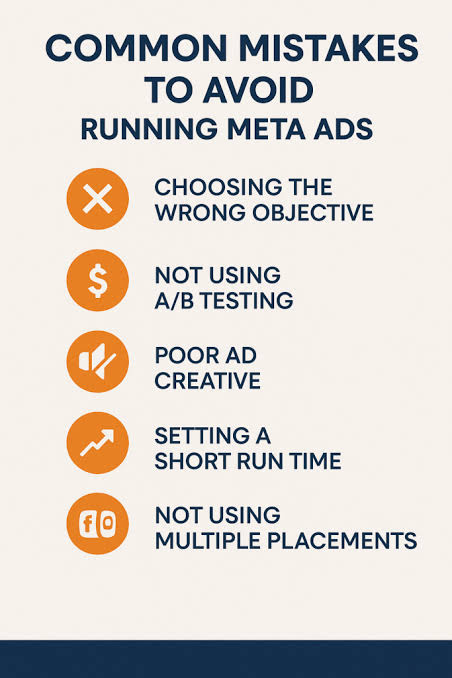
1. Boosting Every Post
Boosting can increase distribution, but it isn’t a replacement for a properly structured advertising strategy.
If your objective is leads or sales, build the campaign around that objective.
2. Using One Creative
One creative gives you very little information about what your audience actually responds to.
Test different angles.
3. Obsessing Over Cheap Leads
Cheap leads aren’t automatically good leads.
Measure what happens after the lead.
4. Changing Campaigns Too Frequently
Constant changes can make it difficult to determine what is actually working.
Give your tests enough time and data to produce useful signals.
5. Ignoring the Landing Page
A great advertisement cannot fix a poor conversion experience.
6. Measuring Only CTR or CPM
A cheap click is not the same thing as a profitable customer.
7. Ignoring Creative Fatigue
Even a winning advertisement can eventually stop performing.
Keep developing new creative angles.
The WebDreams Approach to Meta Ads
At WebDreams, we don’t look at Meta advertising as simply:
Create Ad → Get Leads
We look at it as:
Research → Creative → Audience → Offer → Funnel → Tracking → Testing → Optimization → Revenue
The execution matters.
We test creatives.
We test messaging.
We test audiences.
We test landing pages.
We test conversion points.
We test the funnel.
And then we look beyond the lead count.
For lead-generation campaigns, we want to understand lead quality, qualified opportunities, customer acquisition cost and revenue.
For e-commerce campaigns, we look at AOV, ROAS and profitability.
Because getting 1,000 leads doesn’t matter if none of them become customers.
Getting 100 sales doesn’t necessarily matter if every sale loses money.
The goal is profitable growth.
You can explore our Social Media Marketing services to see how WebDreams approaches paid social, campaign strategy, creative and performance marketing.

Final Thoughts: Running Meta Ads Is Easy. Running Them Profitably Is the Skill.
The technical process of creating a Meta ad is straightforward.
Set up your account.
Choose an objective.
Create your campaign.
Define the audience.
Set your budget.
Create your ads.
Add tracking.
Launch.
But that’s only the beginning.
The real advantage comes from what happens afterward.
Test. Measure. Learn. Improve. Repeat.
And don’t let the platform’s targeting options distract you from the most important part of the campaign:
What are you showing people, what problem are you solving, and what happens after they click?
As Meta’s systems become increasingly automated, marketers need to think less about finding one “perfect audience” and more about producing strong creative, clear offers, reliable conversion signals and a funnel that turns attention into revenue.
That is how you move from running Meta Ads to actually building a Meta Ads growth system.
Ready to Run Meta Ads for Real Business Growth?
Don’t settle for campaigns that only generate impressions, clicks or cheap leads.
Build a Meta advertising strategy focused on qualified customers, revenue and ROI.
Talk to WebDreams about creating, testing and optimizing a Meta Ads campaign for your business.