


Choosing web hosting can be confusing when you are running a business website. Hosting providers often give you several options, and one of the first choices you may see is Linux hosting or Windows hosting.
If you are a business owner rather than a developer, you may naturally wonder:
Does it matter which one I choose?
Is Linux cheaper?
Is Windows more powerful?
Will one make my website faster?
Which one is better for WordPress?
The answer is simpler than it initially looks.
Linux and Windows hosting are not competing versions of the same product. They are different server environments, and the right choice depends primarily on the technology your website needs.
For most small and medium-sized businesses running WordPress, PHP-based websites, and other common web applications, Linux hosting is usually the practical and economical option. Windows hosting is more appropriate when a website or application has specific Microsoft-related requirements.
So, before choosing the cheapest plan or the one that sounds more familiar, let’s understand the actual difference.
What Is Linux Hosting?
Linux hosting means your website is hosted on a server that uses a Linux-based operating system.
Linux is widely used for web servers and works with many of the technologies commonly used to build websites, including PHP, MySQL, MariaDB and a large range of open-source applications.
This makes Linux hosting particularly common for:
- WordPress websites
- Business websites
- Blogs
- E-commerce websites
- PHP applications
- Laravel websites
- Joomla
- Drupal
- Other open-source web applications
For an SME owner, you generally do not need to understand Linux itself to use Linux hosting.
Most hosting providers give you a control panel through which you can manage things such as your website files, databases, email accounts, domains, SSL certificates and backups.
So when you see Linux hosting, think of it as the server environment underneath your website, not something you have to operate from a command line.
What Is Windows Hosting?
Windows hosting uses Microsoft’s Windows Server operating system.
It is designed for websites and applications that need particular Microsoft technologies or Windows-specific server components.
Depending on the application, these can include technologies such as:
- Microsoft IIS
- ASP.NET
- .NET applications
- Microsoft SQL Server
- Other Microsoft-dependent software
There is one important point here.
Not every .NET website automatically requires Windows hosting.
Modern .NET and ASP.NET Core are cross-platform and can run on Linux as well as Windows. Microsoft’s own documentation confirms that ASP.NET can run across Windows, Linux, macOS and Docker environments. (Capnis)
So the old advice of:
“ASP.NET means you must buy Windows hosting.”
is too simplistic today.
The actual technology stack and application requirements should be checked before choosing the server environment.
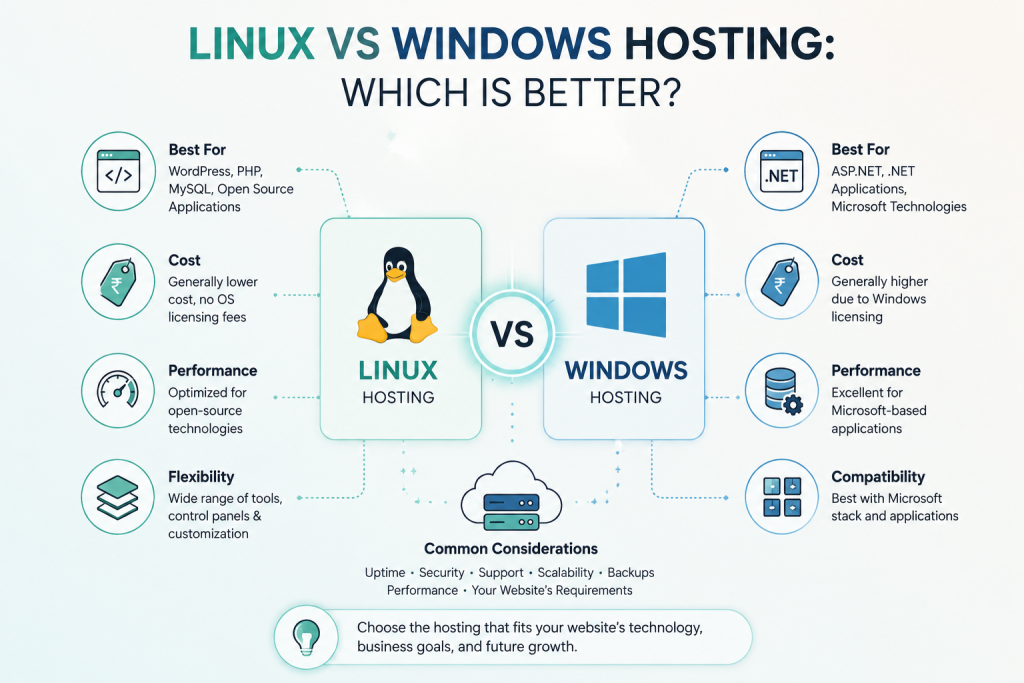
Linux vs Windows Hosting: What Is the Difference?
Here is the simple comparison.
| Factor | Linux Hosting | Windows Hosting |
|---|---|---|
| Operating system | Linux | Windows Server |
| Common use | WordPress, PHP and open-source applications | Microsoft-based applications and specific Windows requirements |
| WordPress | Excellent fit | Can work, but usually unnecessary |
| Common web technologies | PHP, MySQL, MariaDB and many open-source stacks | ASP.NET, IIS, Microsoft SQL Server and other Microsoft technologies |
| Cost | Usually more economical | Often higher because of Windows licensing |
| Common control panels | cPanel and others | Plesk and others |
| Best for | Most standard business websites | Applications with specific Microsoft requirements |
| Future flexibility | Strong for common web stacks | Strong when Microsoft infrastructure is required |
The important thing is that neither operating system is universally better.
The better option is the one that matches your website.
Linux vs Windows Hosting: Which Is Cheaper?
For most businesses, this is one of the first practical questions.
Linux hosting is generally the more economical option.
One reason is that Linux is open source, whereas Windows Server involves licensing costs. Those costs can become part of the hosting provider’s infrastructure expenses and, ultimately, the price of the hosting plan.
Current hosting comparisons in India also generally position Linux hosting as the lower-cost option, while Windows hosting tends to carry a premium where Windows licensing and Microsoft-specific infrastructure are involved.
But there is an important distinction:
Cheap hosting is not always cheaper for your business.
Suppose your website requires a Windows-specific application.
You could choose a cheaper Linux plan, but if your application does not work correctly there, you have not saved money. You have created a technical problem.
The better way to think about hosting cost is:
Cost of hosting + suitability for your website + performance + support + ability to grow.
For a standard WordPress business website, Linux can give you everything you need without paying for a Windows environment you do not require.
For a Microsoft-dependent application, the additional cost of Windows hosting may be justified.
Is Linux Hosting Better for WordPress?
For most WordPress websites, Linux hosting is the natural choice.
WordPress requires a compatible PHP environment and database, and Linux hosting is widely used for this combination. WordPress itself recommends a hosting environment supporting PHP and a suitable database, rather than requiring Windows hosting.
This is why you will commonly see Linux hosting recommended for:
- WordPress
- WooCommerce
- PHP websites
- MySQL or MariaDB databases
- Many popular CMS platforms
If you are an SME owner planning a standard company website with WordPress, there is usually no business reason to choose Windows hosting simply because your office computers run Windows.
Remember:
Your computer’s operating system and your website’s server operating system are two different things.
You can use a Windows laptop and host your website on Linux without any problem.
Is Linux Hosting Faster Than Windows Hosting?
This is where many hosting articles oversimplify the answer.
You will often see people claim:
Linux hosting is faster than Windows hosting.
That is not a useful rule by itself.
Your website’s performance depends on much more than the server operating system.
It can be affected by:
- Server CPU
- RAM
- Storage technology
- Database configuration
- Web server configuration
- Caching
- CDN
- Website code
- Images
- Plugins
- Traffic
- Network quality
- Hosting architecture
A well-configured Windows server can perform very well. A poorly configured Linux server can perform badly.
For an SME, the more useful question is therefore not:
“Is Linux faster?”
It is:
“Which hosting environment gives my website enough resources and is properly configured for the technology I am using?”
This is especially important as your website grows.
A website receiving 500 visitors a month and a website handling tens of thousands of visitors cannot be evaluated using the same hosting requirements.
Is Linux Hosting More Secure Than Windows Hosting?
This is another area where you should be careful with simple “Linux wins” claims.
Both Linux and Windows Server can be securely configured and both can have vulnerabilities.
Your website’s security depends on several layers, including:
- Server configuration
- Operating system updates
- Website software
- Plugins
- Password security
- Firewalls
- Malware protection
- Backups
- Access controls
- SSL/TLS
- Hosting provider practices
For an SME owner, the hosting provider’s security practices may be more important than trying to decide which operating system is theoretically safer.
A secure Linux server is valuable.
A secure Windows server is valuable.
An outdated and poorly managed server is a problem regardless of its operating system.
What About cPanel and Plesk?
The hosting control panel is another factor that can confuse beginners.
cPanel is widely associated with Linux hosting and is commonly used to manage websites, domains, databases, email and other hosting functions.
Plesk supports both Linux and Windows environments and is particularly common in Windows hosting. (Host.co.in)
For an SME owner, however, the control panel should not be the first thing you use to decide between Linux and Windows.
First ask:
What technology does my website need?
Then:
Which hosting environment supports it?
Then:
Which hosting plan gives me the resources, security and support I need?
The control panel comes after those decisions.
This is also why cPanel vs Plesk deserves its own comparison rather than being mixed heavily into this article.
Which Hosting Should an SME Choose?
If you own a small or medium-sized business, you probably do not need to make the decision based on technical specifications alone.
Use your website as the starting point.
Choose Linux hosting if your website uses:
- WordPress
- PHP
- MySQL or MariaDB
- WooCommerce
- Laravel
- Joomla
- Drupal
- Other common open-source technologies
For a normal company website, blog or WordPress-based business website, Linux will usually be the practical choice.
Consider Windows hosting if your website or application requires:
- Windows Server-specific functionality
- IIS
- Microsoft SQL Server in a Windows-specific setup
- Legacy ASP applications
- Other Microsoft-dependent infrastructure
If you are unsure, ask your developer or hosting provider:
“What server environment does my website actually require?”
That one question can prevent you from buying the wrong hosting plan.
What Should You Choose If You Are Starting a New Business Website?
Let’s say you are starting a small business today.
You have:
- A domain name
- A company website
- Five to ten pages
- A contact form
- Business email
- A blog
- Maybe an enquiry-generation campaign
You probably do not need an expensive server.
For a standard WordPress or PHP-based business website, a good Linux hosting plan is likely to be sufficient.
Your priorities should instead be:
Reliability
Security
Performance
Backups
Support
SSL
Enough storage and resources
An easy upgrade path
The operating system is important, but it is only one part of the decision.
Start with the basics: Your domain name identifies your business online, while hosting provides the infrastructure where your website is stored and served to visitors. If you have not registered your domain yet, you can explore available domain options through WebsiteDomains.in and then choose a hosting environment that matches your website’s technology.
What If My Business Grows?
This is where SME owners should think beyond today’s hosting bill.
Your website might start as a simple brochure website.
Three years later, it could become:
- A lead-generation platform
- An e-commerce store
- An online booking system
- A customer portal
- A membership website
- An application connected to your CRM
- A website receiving significantly more traffic
Your hosting requirements may change as your business changes.
That does not mean you should buy an expensive server today just because you might grow.
Instead, choose a provider that allows you to move to a more capable hosting plan when you need it.
The important question is not:
“What is the most powerful hosting I can buy?”
It is:
“What is the right hosting for my business today, and can I scale it when I need to?”
That is a much better long-term approach.
The Industry Reality: Linux or Windows?
The current hosting market makes one thing fairly clear.
Linux is the mainstream choice for common websites.
It fits the technologies behind WordPress and many other open-source applications, and its open-source licensing model generally allows hosting providers to offer competitive pricing. Current comparisons continue to position Linux as the default choice for WordPress, PHP and other common web stacks. (Host IT Smart)
Windows hosting is more specialised.
It remains important for businesses that have applications or infrastructure built around Microsoft technologies.
So the industry reality is not:
Linux is good and Windows is bad.
It is:
Linux is the default for many websites. Windows exists for specific requirements.
That distinction is much more useful when you are actually spending money on hosting.
Linux vs Windows Hosting: Which One Should You Buy?
Here is the simplest way to decide.
Linux Hosting is probably right for you if:
You have a WordPress website.
You have a PHP website.
You are building a normal business website.
You are using WooCommerce or another common open-source platform.
You want a cost-effective hosting environment.
Windows Hosting may be right for you if:
Your application has a specific Windows Server requirement.
Your existing infrastructure depends on Microsoft technologies.
Your developer specifically recommends Windows hosting for your application.
You require a Windows-specific service that your Linux environment cannot provide.
If none of these Windows-specific requirements apply, Linux is generally the sensible starting point.
Don’t Choose Hosting Based Only on Price
There is a temptation when buying hosting to compare plans based only on the monthly price.
That can be a mistake.
A ₹100 difference in monthly hosting cost is insignificant if the cheaper plan gives you poor support, insufficient resources, weak backups, or performance problems.
Likewise, paying considerably more for Windows hosting makes little sense if your WordPress website does not need anything Windows-specific.
Instead, compare:
| What to check | Why it matters |
|---|---|
| Price | Determines your ongoing cost |
| Storage | Determines how much website data you can keep |
| CPU and RAM | Affect how your website handles workloads |
| Performance | Important for visitors and conversions |
| Uptime | Keeps your website available |
| Backups | Helps recover from problems |
| Security | Protects your website and business |
| Support | Important when something goes wrong |
| Scalability | Allows you to upgrade as traffic grows |
| Technology support | Ensures your website actually works |
This is what separates buying hosting from buying the right hosting.
Frequently Asked Questions
Is Linux hosting better than Windows hosting?
Neither is universally better. Linux is usually the practical choice for WordPress, PHP and many open-source websites. Windows is more suitable when an application has specific Microsoft or Windows Server requirements.
Is Linux hosting cheaper than Windows hosting?
Linux hosting is generally more economical because Linux is open source and Windows Server involves licensing costs. However, actual prices depend on the provider, resources and features included in the plan.
Is Linux hosting better for WordPress?
Yes, Linux is generally the natural choice for WordPress because WordPress commonly runs on PHP and databases such as MySQL or MariaDB, technologies widely supported by Linux hosting.
Can WordPress run on Windows hosting?
Yes. WordPress can run on Windows hosting when the required PHP and database environment is properly configured. However, for a typical WordPress website, there is usually no need to choose Windows hosting simply because WordPress can technically run there.
Do I need Windows hosting if I use .NET?
Not necessarily. Modern .NET and ASP.NET Core are cross-platform and can run on Linux or Windows. Your hosting choice should be based on the application’s specific requirements.
Does Linux hosting make a website faster?
Not automatically. Website speed depends on server resources, configuration, website code, caching, database performance, storage, network quality and many other factors. The operating system is only one part of the infrastructure.
Which hosting is best for a small business?
For a typical WordPress or PHP-based small business website, Linux hosting is generally the practical option. If the website requires Microsoft-specific infrastructure, Windows hosting may be more appropriate.
Final Verdict
For most SME websites, Linux hosting is the sensible choice.
If your website uses WordPress, PHP or common open-source technologies, Linux gives you a widely supported and generally cost-effective environment.
Windows hosting is not obsolete or inferior. It has an important role when your website or application depends on Microsoft technologies or Windows-specific requirements.
The smartest approach is therefore not to ask:
“Which operating system is better?”
Ask:
“Which hosting environment is right for my website today, and can it support my business as it grows?”
That question will lead you toward a better hosting decision than simply choosing the cheapest plan.
WebDreams Perspective
At WebDreams, we believe the right hosting solution should support your business today while giving you the flexibility to grow tomorrow. Whether you need Linux or Windows hosting, the right choice depends on your website technology, performance requirements, security, budget, and future plans. WebDreams provides hosting solutions on both Linux and Windows platforms, helping businesses choose an environment that fits their website and business needs. (WebDreams India)