

A customer review looks like a small piece of feedback.
It might be just a few sentences and a star rating on Google. But for a business, a review can influence much more than its online rating.
It can affect how a potential customer sees your business, whether they trust you, whether they choose you over a competitor, and what they expect when they contact you.
For local businesses, reviews are also part of the information customers see when they discover a business through Google Search and Maps. Google itself says reviews and positive ratings can contribute to local prominence. (Google Support)
But there is an important point that businesses often miss:
Customer reviews are not only a visibility strategy. They are a feedback system, a trust signal, a sales asset, and a source of information about your business.
That is why reviews deserve to be treated as part of the overall customer and marketing strategy.
What Makes Customer Reviews So Important?
Think about your own buying behaviour.
If you are choosing between two restaurants, which one are you more likely to consider?
Restaurant A
4.1 stars, 37 reviews
or
Restaurant B
4.7 stars, 1,200 reviews
The numbers immediately create an impression.
You haven’t spoken to either restaurant.
You haven’t tasted the food.
You haven’t met the owner.
Yet you already have an expectation about the experience.
That is the power of social proof.
Customer reviews allow previous customers to influence the decisions of potential customers.
And this happens across almost every industry:
- Restaurants
- Hotels
- Doctors
- Salons
- Retail stores
- E-commerce businesses
- Real estate companies
- Educational institutions
- IT companies
- Digital agencies
- Professional services
Reviews help reduce the uncertainty that exists before a purchase.
Reviews Build Trust Before the First Conversation
A potential customer may discover your business through Google, social media, an advertisement, a referral, or your website.
But discovery doesn’t automatically create trust.
The customer is still thinking:
“Can I trust this business?”
Reviews help answer that question.
A business can say:
“We provide excellent service.”
But that is the business talking about itself.
A customer saying:
“They understood our requirements, completed the website on time, and continued supporting us after launch.”
carries a different kind of credibility.
This is why customer reviews can become one of the most useful forms of social proof a business has.
Reviews Affect Sales
Reviews are closely connected to sales because they influence the customer’s decision before the sales conversation even begins.
Consider two businesses offering a similar service.
Both have:
- Similar pricing
- Similar services
- Similar websites
- Similar locations
But one has dozens of recent, detailed customer reviews while the other has almost none.
The customer has an additional reason to choose the first business.
Reviews can answer questions that your sales team otherwise has to answer repeatedly.
For example:
Was the service good?
Was the business responsive?
Was the product reliable?
Did they deliver on time?
Was the support good after the purchase?
Would customers recommend them?
This makes reviews part of the sales process even though nobody from your sales team wrote them.
Reviews Are Also Customer Feedback
This is one of the most important reasons to collect reviews.
Businesses sometimes look at reviews and ask:
“How many five-star reviews did we get?”
That’s useful, but incomplete.
A better question is:
“What are customers telling us?”
A review can reveal:
- What customers appreciate
- Where customers experience problems
- What employees are doing well
- Where communication is weak
- What products customers prefer
- What expectations aren’t being met
- What customers want improved
For example, imagine a restaurant repeatedly receives comments saying:
“Food was excellent, but service was slow.”
The business shouldn’t simply celebrate the positive rating.
It should investigate the service problem.
Now the review has become operational data.
A Negative Review Isn’t Always Bad
Nobody wants negative reviews.
But trying to eliminate all negative feedback isn’t the right objective.
A genuine negative review can tell you something important.
Perhaps:
- Delivery was late
- Customer support didn’t respond
- The product didn’t meet expectations
- Staff communication was poor
- The website had a problem
- The customer misunderstood the service
The response matters.
A thoughtful response can show that the business listens and is willing to address problems.
Google also recommends responding to reviews because it shows customers that their feedback matters. (Google Support)
The goal isn’t to pretend that every customer is happy.
The goal is to listen, learn, and improve.
Customer Care Is Still a Human Business
This becomes especially important as businesses introduce AI into customer support.
AI can be useful.
It can answer common questions, provide information, route enquiries, and handle repetitive tasks.
But there are situations where customers don’t want another automated response.
They want someone to understand their problem.
Imagine a customer has paid for a service, something has gone wrong, and they have already contacted support twice.
Receiving another automated:
“Thank you for contacting us. Please select from the following options.”
can make the situation worse.
A human being can understand context, emotion, frustration, and unusual situations in ways automated systems may not.
This doesn’t mean businesses should avoid AI.
It means AI should support customer care, not replace human responsibility where human judgement is needed.
And ultimately, the customer experience will often appear in the review.
Reviews Connect Customer Service With Marketing
This is where the relationship becomes interesting.
A business might think of these as separate departments:
Customer Service
Marketing
Sales
SEO
Reputation Management
But customer reviews connect all of them.
The process can look like this:
Good Product/Service
↓
Good Customer Experience
↓
Customer Feedback
↓
Positive Review
↓
More Trust
↓
More Enquiries
↓
More Customers
↓
More Customer Experiences
It creates a cycle.
But the cycle works only if the business actually delivers a good experience.
You cannot build a sustainable review strategy around poor customer service.
How Reviews Help Local SEO
For local businesses, Google reviews are particularly important.
When people search for businesses through Google Search or Maps, they may see the business’s review score and customer feedback alongside other information.
Google states that local results are influenced by relevance, distance, and prominence, and that prominence can include signals such as links to the business and the number of reviews it has. (Google Support)
This is why reviews can contribute to local search visibility.
For example:
“Best restaurant near me”
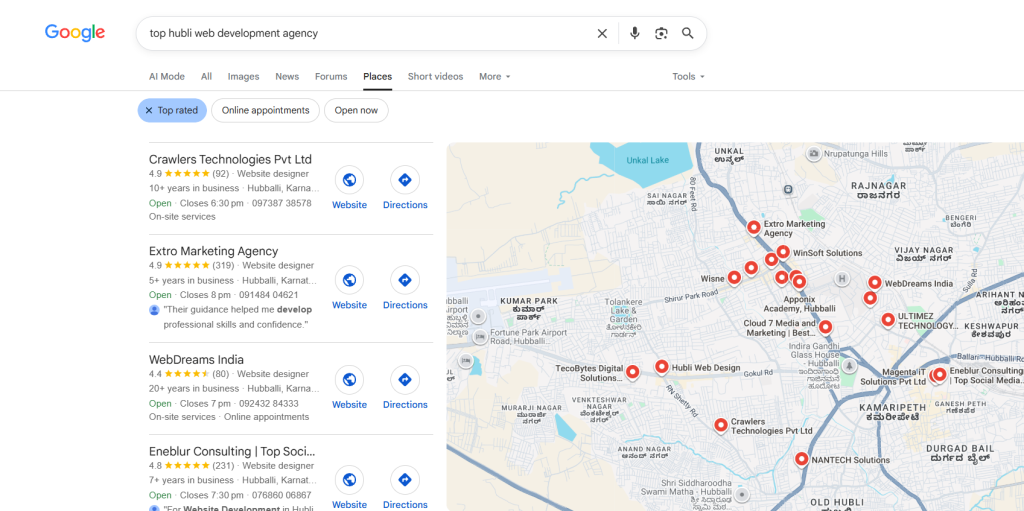
“Digital marketing company in Hubli”
“Dentist near me”
“Best hotel in Belgaum”
The customer isn’t simply looking for a website.
They’re looking for a business they can trust.
A strong Google Business Profile with genuine reviews can therefore become an important part of a local business’s online presence.
More Reviews Can Create More Visibility, But Don’t Chase Numbers Alone
It is tempting to think:
More reviews = higher ranking = more customers.
Reality is more complicated.
Reviews are one part of a larger local search ecosystem.
Google also considers relevance, distance, and prominence. (Google Support)
So businesses shouldn’t focus only on collecting the largest possible number of reviews.
Focus on:
- Genuine customer experiences
- Consistent review activity
- Honest feedback
- Detailed experiences
- Appropriate responses
- Accurate business information
- Overall customer satisfaction
And never buy or manufacture reviews.
Google explicitly prohibits incentives in exchange for reviews and considers that fake engagement. (Google Support)
Reviews Can Tell Search Engines More About Your Business
A review doesn’t just contain a star rating.
It can contain words describing the customer’s experience.
For example:
“We hired WebDreams for our e-commerce website and their team helped us with design, development and SEO.”
That review provides context about:
- The company
- The service
- The customer’s experience
- The type of project
This is one reason genuine, detailed reviews are more useful than reviews that simply say:
“Good company.”
You should never tell customers what to write or ask them to insert keywords.
Instead, encourage honest feedback about their actual experience.
Reviews Influence More Than Google
Although Google reviews are particularly important for local businesses, customers may also look at:
- Industry directories
- Marketplace reviews
- Third-party review websites
- Testimonials on your website
The broader point is that people research businesses across multiple platforms.
A strong reputation should therefore exist beyond a single profile.
This is particularly important when customers are making higher-value decisions.
Someone buying a ₹500 product may make a quick decision.
Someone spending ₹5 lakh on a website, software system, renovation, education, or professional service may conduct considerably more research.
Reviews can become part of that research.
Reviews Can Become Marketing Content
A good customer review doesn’t have to remain buried on Google.
With permission and appropriate handling, genuine customer feedback can inspire other marketing assets.
For example:
Review
“The new website made it easier for customers to find our services.”
Can become:
Website Case Study
Review
“Their team helped us generate qualified leads through digital marketing.”
Can become:
Marketing Case Study
Review
“Support was responsive even after the project was completed.”
Can become:
Customer Experience Testimonial
The review becomes the starting point for stronger content.
Reviews Can Help Your Sales Team
Sales teams can use customer feedback to understand what customers care about.
Suppose your reviews repeatedly mention:
“Fast response”
That tells you responsiveness is a meaningful part of your value proposition.
Or customers repeatedly mention:
“Easy to work with”
That tells you simplicity and communication may be important differentiators.
Your sales messaging can then reflect what customers actually value.
This is much stronger than inventing a marketing message in a conference room.
Your customers are telling you what they value.
Listen to them.
What Makes a Good Customer Review Strategy?
A review strategy shouldn’t be:
“Send everyone a link and ask for five stars.”
It should be part of the customer journey.
1. Deliver a Good Experience
The foundation is always the actual product or service.
2. Ask at the Right Time
Ask customers after a meaningful positive interaction or completed experience.
3. Make It Easy
Google allows businesses to create a review link or QR code that can be shared with customers. (Google Support)
4. Ask for Honest Feedback
Don’t tell customers what rating or wording to use.
5. Respond
Thank customers for positive feedback and address genuine concerns professionally.
6. Learn From Patterns
Don’t analyse every review in isolation.
Look for recurring themes.
7. Improve the Business
The best review strategy ultimately improves the customer experience itself.
What Businesses Should Not Do
There are several mistakes businesses should avoid.
Buying Reviews
Fake reviews can damage trust and violate platform policies.
Offering Rewards for Positive Reviews
Don’t offer discounts, gifts, or other incentives in exchange for reviews. Google prohibits this practice. (Google Support)
Asking Only Happy Customers
A review strategy should reflect genuine customer experiences.
Ignoring Negative Reviews
Silence can make a problem worse.
Arguing With Customers Publicly
Even when you disagree with a review, remain professional.
Copying the Same Response
A generic:
“Thank you for your valuable feedback.”
on every review can feel automated.
Personalize your responses where appropriate.
Customer Reviews and Business Reputation
A business that wants to scale needs more than sales.
It needs a reputation.
Think about the difference between:
“We need more customers.”
and:
“We need more customers who trust us enough to choose us.”
Reviews help bridge that gap.
They are evidence of previous customer experiences.
Over time, those experiences can become part of the reputation of the business.
That reputation can influence future purchases, partnerships, hiring, referrals, and sales conversations.
Reviews Are an Asset, Not Just a Number
Businesses often display:
4.8 ★
and move on.
But the real value is deeper.
Behind that number are hundreds of customer experiences.
Those experiences can influence:
Trust
↓
Consideration
↓
Enquiries
↓
Sales
↓
Retention
↓
Referrals
And the feedback can also help the business identify what needs improvement.
That makes customer reviews both a marketing asset and a management tool.
How WebDreams Can Help Businesses Build Better Online Visibility
Reviews work best when they are part of a broader digital strategy.
Your Google Business Profile, website, SEO, content, social media, customer experience, and online reputation should support one another.
WebDreams helps businesses strengthen their online presence through SEO, digital marketing, website development, content, and related digital strategies.
For example, WebDreams has also published a guide on how Google My Business impacts business growth and customer acquisition, which can be used as a related resource for businesses working on their local visibility.
Is Your Online Reputation Helping You Win Customers?
Your customers are already talking about your business.
The question is whether your online presence is making that feedback work for you.
WebDreams can help you build a stronger digital presence through SEO, Google Business Profile optimization, website development, content, and digital marketing.
Want More Customers to Find and Trust Your Business?
Build an online presence that brings together visibility, credibility, customer feedback, and conversion.
Talk to WebDreams about your digital marketing and SEO strategy.
Final Thoughts
Customer reviews are much more than stars on Google.
They are:
Social proof
Customer feedback
Sales support
Reputation management
Local visibility
Marketing content
Business intelligence
And most importantly, they are a reflection of the customer experience your business creates.
AI can help businesses answer questions faster.
Automation can make operations more efficient.
Digital marketing can bring more people to your business.
But none of these replaces the fundamental requirement:
Give customers a reason to say something good about you.
Then listen when they tell you what you could do better.
A business that consistently delivers a good experience, encourages genuine feedback, responds professionally, and learns from its customers is not just building reviews.
It is building a reputation that can compound over time.
