

Just imagine you are launching a brand new business. You have a fantastic product, your inventory is ready and your doors are open. Now you face ultimate business challenge that is, How do you get people to know your business exists?
To attract customers, you must use marketing. Marketing is the act of introducing your products and services to the people at the right time. However when you look at your advertising options in today’s world, you will find that marketing is split into two completely different worlds : Traditional Marketing and Digital Marketing.
For decades the business had only traditional marketing to rely on. But in today’s world the digital marketing has taken over the world.
What is Traditional Marketing ?

Traditional marketing refers to any type of advertising that does not make use of internet. Traditional marketing is the “old-school” way of marketing that businesses have used for over a century. If you can physically touch an ad or hear an ad without any internet connection then it is almost traditional marketing.
Traditional Marketing Channels
- Print ads (newspaper, magazines)
- Broadcast ads (television, radio)
- Outdoor ads (billboards, bus stop posters)
- Direct mail (flyers, catalogue)
Traditional marketing relies heavily on placing ads where large groups of people gather in the physical world. For example, a business might buy a billboard on a busy highway assuming that thousands of passer will drive past it every single day.
What is Digital Marketing ?

Digital marketing is exact opposite to traditional marketing. Advertising that happens over the internet or on an electronic device. If you need smartphone, tablet, computer or internet connection to see the advertisement then these fall under the digital marketing.
Digital Marketing Channels
- Social media (instagram, facebook)
- Search engines (google search optimization)
- Email marketing (newsletters, discount codes)
- Video ads (youtube ads, web banners)
Digital marketing allows businesses to have their own platform to interact their products smoothly into a user’s daily online life. Instead of broadcasting a single message to an entire city, digital marketing focuses on showing the tailored ads to the specific individuals based on what they are currently browsing or interested in online.
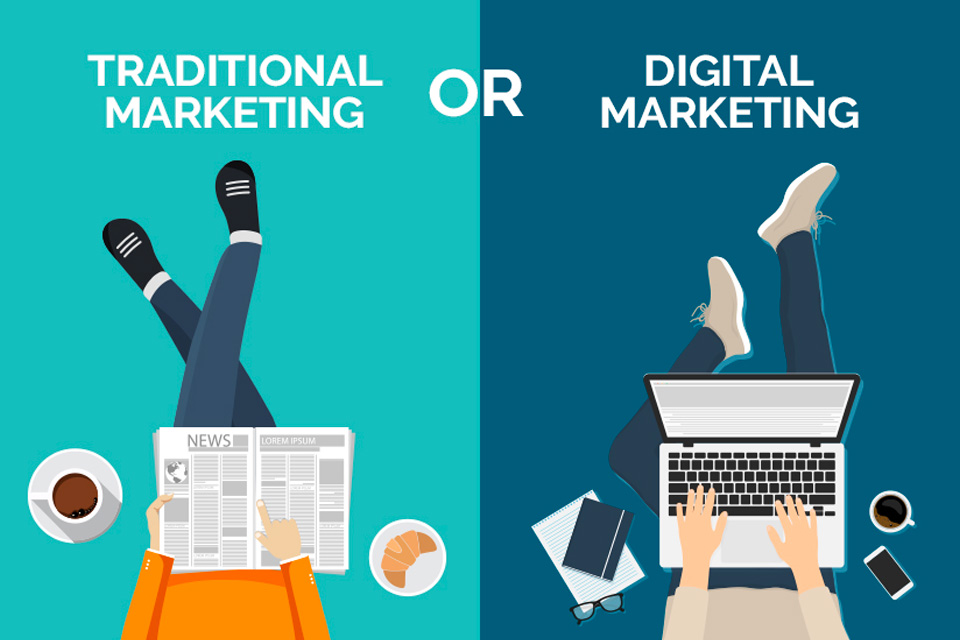
The main differences: Traditional vs Digital Marketing
So to truly understand how these two methods setup against each other, we can compare them across four critical business categories: Audience Targeting, Tracking Results, Cost and Interaction.
- Audience Targeting (Who sees your ad?)
- Traditional Marketing is Broad: Think of traditional marketing like throwing a giant net into the ocean. You might catch a few fish you want, but you will also catch a lot of things you do not want have but If you place an ad in a local newspaper, everyone who buys that paper sees your ad, regardless of whether they are a teenager, a retired grandparents, a student or a CEO. You are paying to show your ad to people who may have zero interest in your product.
- Digital Marketing is Specific: Digital marketing works like a laser-guided tool where online platforms collect data on user interests, you can choose exactly who sees your ad. If you sell vegan dog treats, you can set your digital ads to appear only to people who are between the ages of 25 and 40, live within 5 kilometres of your shop, follow vegan cooking pages and own a dog. You do not waste a single penny showing your ad to non-dog owners.
- Tracking Results (How do you know it worked)
- Traditional Marketing is a Guessing Game: Imagine you print 5,000 flyers and hand them out across your city. Two weeks later, your shop sees a jump in sales. How do you know if the flyers caused the surge? Did customers see the flyer or did they just wander in by accident? With traditional marketing it is incredibly difficult to measure your exact return on investment (ROI).
- Digital Marketing is Data-Driven: Digital marketing provides complete transparency. If you launch an online ad, software dashboards show you exact numbers in real time. You will know precisely how many people saw your ad, how many clicked it, what time they clicked it and exactly how many of those clicks turned into actual sales. If an ad isn’t working, you can see the failure immediately and fix it.
- Cost and Flexibility (How much does it cost?)
- Traditional Marketing is Expensive and Rigid: Buying a television spot, printing thousands of physical brochures or renting a roadside billboard requires a significant upfront financial commitment. Furthermore, traditional ads are permanent once produced. If you print 10,000 flyers and realize there is a massive spelling mistake or an incorrect phone number on them, your only option is to throw them away, lose your money and reprint them from scratch.
- Digital Marketing is Affordable and Flexible: Digital marketing scales easily fit any budget. You can start a social media advertising campaign with as little as ₹500 or $5 a day. This low barrier to entry allows small startups to compete directly with multi-million dollar corporations. Additionally, digital ads are highly flexible. If you spot a typo in an active online ad, you can press a button, edit the text instantly or completely pause the campaign without losing your initial investment.
- Communication and Interaction (How do customers react?)
- Traditional Marketing is a One-Way Street: Traditional marketing forces a message onto the consumer. The business talks and the consumer simply listens or ignores them. There is no way for a customer to click a newspaper ad to ask a quick question, leave a public review or instantly purchase the product.
- Digital Marketing is a Two-Way Street: Digital marketing creates an active conversation. When you post a picture of a new product on Instagram or Facebook, your customers can instantly comment with questions, share the post with their friends, save it for later or click a direct link to buy the item in under sixty seconds. This instant interaction builds deep trust and community between the brand and the consumer.
Pros and Cons of Both Methods
To help you see the complete picture, let us examine the benefits and drawbacks of both approaches.
Traditional Marketing
- Pros: It is highly effective for targeting local, older demographics who do not spend much time online. Physical items like an attractive business card, a beautifully printed catalog or a large storefront sign leave a tangible, long-lasting impression that digital pixels sometimes cannot match.
- Cons: The high cost often prices out small business owners. It takes weeks or months to see if a campaign was successful and you cannot easily change your message once it is printed or broadcasted.
Digital Marketing
- Pros: It is exceptionally cost-effective, hyper-targeted and completely measurable. It allows you to build personal relationships with your customers through daily online interactions and gives your business access to a global customer base right from your laptop.
- Cons: The digital world is incredibly crowded and noisy, making it easy for your ads to get scrolled past or ignored. Furthermore, online platforms and search engine algorithms change constantly, requiring business owners to continuously learn new digital tools and strategies to stay visible.
Conclusion: Which One Should You Choose?
The debate is not truly about choosing one method and completely ignoring the other. Instead, the most successful modern businesses use a hybrid approach that combines the best parts of both worlds.
If you run a local coffee shop, you might place a physical chalkboard sign outside your front door (traditional marketing) to attract pedestrians walking by. At the very same time, you might run a local Instagram ad campaign (digital marketing) offering a 10% discount code to office workers in your immediate neighbourhood.
For beginners with limited budgets, starting with digital marketing is almost always the smartest move. It keeps your financial risk extremely low, gives you instant feedback on what your customers like and provides you with the exact tools you need to grow your business at your own comfortable pace.