If your website still runs on an old hard drive or even a traditional SATA SSD you may be leaving performance on the table.
NVMe hosting has become increasingly popular because it uses a newer storage protocol and PCIe interface to deliver lower latency and significantly higher input/output performance than traditional storage technologies.
For websites that rely heavily on databases, run e-commerce stores, handle large numbers of visitors, or operate multiple applications, faster storage can make a noticeable difference.
But is NVMe hosting actually worth paying for? And how different is it from regular SSD hosting?
Let’s break it down.
What Does NVMe Actually Mean?
NVMe stands for Non-Volatile Memory Express.
It is a storage protocol designed specifically for modern flash-based storage.
The easiest way to understand it is to compare it with older storage technology.
Traditional hard drives use spinning magnetic disks. SATA SSDs replace those mechanical disks with flash memory, making them much faster. However, SATA SSDs still communicate through the older SATA/AHCI interface, which was originally designed around the limitations of hard drives.
NVMe was designed from the ground up for flash storage.
Instead of relying on the older SATA interface, NVMe devices communicate through PCI Express (PCIe). This allows them to handle more parallel operations while reducing latency.
In simple terms:
- HDD: Mechanical storage with relatively high latency
- SATA SSD: Flash storage with much lower latency
- NVMe SSD: Flash storage using a modern, high-speed PCIe interface
That difference is what makes NVMe particularly useful for performance-sensitive workloads.
What Is NVMe Hosting?
NVMe hosting is web hosting that stores your website data on NVMe SSD storage.
Your website’s files, databases, applications, and other data are stored on NVMe drives instead of traditional HDDs or SATA SSDs.
This matters because a web server constantly needs to read and write data.
For example, when someone visits a WordPress website, the server may need to:
- Retrieve website files.
- Query the database.
- Load plugins and application data.
- Process PHP requests.
- Write or retrieve cached information.
- Deliver the resulting page to the visitor.
Faster storage can reduce the time spent waiting for storage operations, particularly when the workload involves frequent or simultaneous disk access.
However, storage is only one part of website performance. A fast NVMe drive cannot compensate for an overloaded CPU, insufficient RAM, poorly optimized code, excessive plugins, or unoptimized images.
Why Is NVMe Hosting Becoming So Popular?
There are several reasons NVMe hosting is increasingly common.
1. Websites Are Becoming More Resource-Intensive
Modern websites are no longer just collections of HTML pages.
A typical business website may use:
- WordPress or another CMS
- Database-driven content
- Page builders
- Analytics tools
- Marketing automation
- Customer forms
- APIs
- E-commerce functionality
- Membership systems
- Caching and security applications
All these components can create additional server-side workloads.
For database-heavy websites, faster storage can help reduce storage-related bottlenecks.
2. Businesses Care More About Website Speed
Website speed affects more than just user experience.
A slow website can make visitors wait longer, increase friction during browsing, and potentially reduce conversions.
Google also uses page experience signals, including Core Web Vitals, as part of its broader ranking systems.
However, it’s important to understand that NVMe does not automatically improve your Google rankings.
Your site’s Core Web Vitals depend on many factors, including:
- Server response time
- Hosting infrastructure
- Website code
- JavaScript
- Images
- Fonts
- Caching
- CDN configuration
- Page structure
- Third-party scripts
NVMe can help with the server/storage side of the equation, but it is only one piece of the performance puzzle.
3. E-Commerce Websites Need Consistent Performance
For an online store, performance matters throughout the customer journey.
Visitors may browse product pages, apply filters, search for products, add items to carts, log into accounts, and complete checkout.
Many of these operations involve database activity.
NVMe storage can be particularly useful for e-commerce websites with larger databases, frequent transactions, or higher traffic volumes.
The benefit isn’t simply “NVMe = more sales.”
Rather, better infrastructure can remove one potential source of performance bottlenecks, allowing the rest of your website optimization work to perform more effectively.
NVMe vs SSD vs HDD: What’s the Difference?
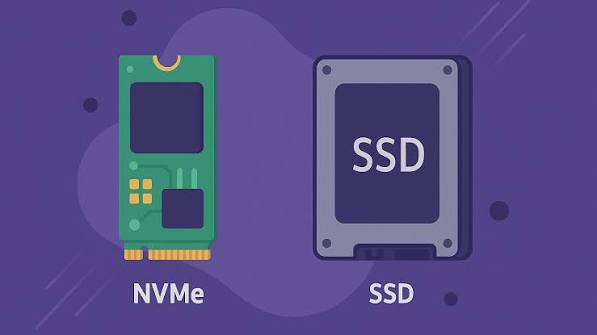
The terms can be confusing because NVMe SSDs are technically SSDs too.
The key difference is the interface and protocol being used.
| Storage | Interface | Typical Performance | Best Suited For |
|---|---|---|---|
| HDD | SATA/SAS | Lowest | Backups, archives, legacy workloads |
| SATA SSD | SATA | Fast | Standard websites and hosting |
| NVMe SSD | PCIe | Very high | Databases, applications, busy websites and high-performance hosting |
The jump from HDD to SSD is generally substantial.
The difference between SATA SSD and NVMe can also be significant, particularly for workloads involving high I/O operations and parallel requests.
But that doesn’t mean every website will suddenly become several times faster after switching to NVMe.
Your actual website performance depends on the entire hosting stack, not storage alone.
Who Should Consider NVMe Hosting?
NVMe hosting can be a good choice if your website falls into one of these categories.
WordPress Websites With Heavy Workloads
A simple WordPress blog may not require high-performance storage.
But a WordPress website running:
- Multiple plugins
- WooCommerce
- Page builders
- Membership functionality
- Large databases
- Dynamic content
can benefit more from faster server infrastructure.
E-Commerce Stores
Online stores typically perform more database operations than simple informational websites.
If you’re running WooCommerce, Magento, or another database-driven e-commerce platform, NVMe can be worth considering.
Websites Experiencing Traffic Growth
As traffic increases, the server has to process more simultaneous requests.
If storage I/O is becoming a bottleneck, upgrading to faster storage can help.
Of course, increasing CPU, RAM, database optimization, caching, or moving to a more powerful hosting architecture may be necessary as well.
Agencies and Resellers
If you’re hosting several websites on the same server, storage performance can become increasingly important.
An NVMe-based environment can provide a stronger foundation for handling multiple websites and workloads.
Database-Heavy Applications
Web applications, membership platforms, learning management systems, and other database-intensive websites can benefit from lower storage latency and higher I/O performance.
What About Small Websites?
You don’t necessarily need NVMe hosting just because it’s newer.
If you operate a small brochure website with a few pages and relatively little traffic, a good SATA SSD hosting plan may already provide more than enough performance.
In other words:
Don’t buy NVMe because it’s a buzzword. Buy it when your website’s workload can benefit from it.
If you’re already investing in SEO, paid advertising, content, and website design, however, upgrading your hosting infrastructure can be a sensible part of a broader performance strategy.
Common NVMe Hosting Myths
Myth 1: “NVMe Will Automatically Make My Website Fast”
Not necessarily.
NVMe can improve storage performance, but your website may still be slow because of:
- Unoptimized images
- Excessive JavaScript
- Poorly written code
- Too many plugins
- Slow database queries
- Lack of caching
- Poor server configuration
- Insufficient CPU or RAM
Think of NVMe as removing one potential bottleneck—not fixing every performance problem.
Myth 2: “NVMe Automatically Improves SEO”
No.
Google doesn’t simply rank a website higher because its server uses NVMe.
Website speed and Core Web Vitals are influenced by many technical and user-experience factors.
NVMe may contribute to better server-side performance, but SEO still requires good content, technical optimization, relevant keywords, links, usability, and many other factors.
Myth 3: “NVMe Is Only for Large Enterprises”
Not anymore.
NVMe storage has become increasingly common across shared hosting, VPS, cloud, and dedicated hosting environments.
That means small businesses can also access NVMe-powered hosting without necessarily investing in enterprise-level infrastructure.
NVMe Hosting Is Only One Part of the Performance Stack
A fast storage device alone doesn’t create a fast website.
Think of website performance as a stack.
Server infrastructure
- NVMe storage
- Sufficient CPU
- Adequate RAM
- Reliable network
- Modern server software
↓
Application layer
- Optimized PHP version
- Efficient database queries
- Lightweight themes
- Carefully selected plugins
- Server-side caching
↓
Front-end
- Compressed images
- Lazy loading
- Efficient CSS and JavaScript
- CDN
- Fewer render-blocking resources
↓
User experience
- Faster page loads
- Better responsiveness
- Smoother navigation
- Less friction during checkout and form submissions
NVMe strengthens the infrastructure layer, but you still need to optimize the layers above it.

Is NVMe Hosting Worth It?
For many websites, yes—but it depends on your workload.
If you’re running a basic website with minimal traffic, upgrading from good SATA SSD hosting to NVMe may not produce a dramatic difference that visitors immediately notice.
But if you’re running an e-commerce store, database-heavy application, busy WordPress website, LMS, membership platform, or multiple client websites, faster storage can become much more valuable.
The important question isn’t:
“Is NVMe faster?”
It is.
The better question is:
“Is storage performance currently limiting my website?”
If the answer is yes, NVMe can be a meaningful upgrade.
Why Choose NVMe VPS Hosting?
If you need more control and dedicated resources than typical shared hosting provides, an NVMe VPS can be the next step.
With a VPS, you get a more isolated hosting environment and greater control over resources and configuration.
For businesses running growing websites, applications, e-commerce stores, or multiple projects, an NVMe-powered VPS can provide a stronger foundation for scaling.
At WebDreams, our NVMe VPS hosting solutions are designed for businesses that need high-performance hosting infrastructure without immediately moving to a dedicated server.
Explore WebDreams’ NVMe-powered VPS hosting plans in India.
Final Thoughts
NVMe hosting isn’t a magic button that makes every website instantly faster.
But it is a meaningful improvement in server storage technology.
Compared with traditional HDDs and SATA-based SSD storage, NVMe offers lower latency and much higher potential I/O performance. For websites with demanding workloads, that can translate into a more responsive hosting environment.
If your website is growing, your database is getting larger, or your current hosting environment is becoming a performance bottleneck, NVMe is worth considering.
And if you’re already spending money on SEO, advertising, content, and website development, don’t overlook the infrastructure underneath it all.
Your website can only perform as well as the foundation it’s built on.